The Orange Democratic Movement (ODM) is currently facing one of the most serious internal crises in its history following the passing of its long-time leader, the late Raila Odinga. What once appeared to be Kenya’s most stable and organised party has lately been beset by deep divisions, power struggles and competing visions for the future as party leaders, members and even family voices jostle for influence ahead of the 2027 General Election.
A Party Without Its Unifying Leader
For decades, Raila Odinga’s presence provided ODM with a clear sense of direction and unity. But since his death, the party has struggled to define its leadership and political strategy. Several senior figures and MPs have publicly expressed concern about the growing rifts, warning that the party risks alienating supporters if it cannot find common ground and move forward with unity. Many members say that internal disagreements are now overtaking the party’s core mission, and that this could open space for rival political formations to gain ground.
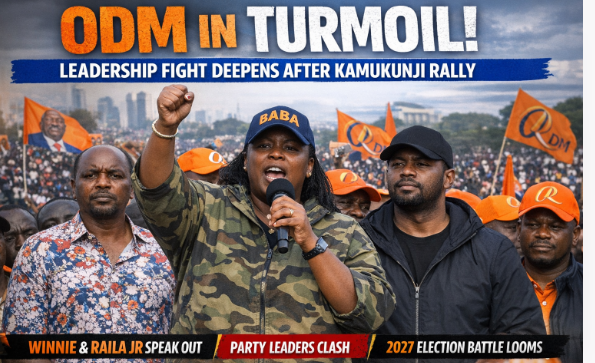
Kamukunji Grounds Rally: Winnie and Raila Junior Speak Out
On Sunday, January 18, ODM’s internal tensions reached a new peak at Kamukunji Grounds in Kibra, where Winnie Odinga, a Member of the East African Legislative Assembly (EALA) and daughter of the late Raila Odinga, took center stage. She was joined by her younger brother Raila Odinga Junior, drawing a large crowd of supporters in what many saw as a direct challenge to elements of the party’s leadership.
During her address, Winnie delivered an emotional message, saying that no one would be forced out of ODM even as conflicting voices rise within the party. She criticised some leaders for what she described as selfish behavior and eagerness to seize control of the party, likening the situation to a bus that has lost its driver and whose passengers are now scrambling for the steering wheel.
Winnie stressed that ODM belongs to the people and not to a select few. She warned that attempts to silence debate or expel dissenting voices would weaken the party rather than strengthen it, insisting that internal democracy and open discussion are vital if ODM is to remain relevant.
Voices Inside and Outside the Party
The Kamukunji rally has inspired both support and criticism. Some party members, such as MP Robert Mbui, praised Winnie for defending the ideals of her late father and warned against prioritising personal ambition over the party’s founding principles. They argue that what ODM needs now is a leadership that listens to grassroots supporters and remains true to its history.
Others, however, have been less supportive. Vocal commentators and some political observers have criticised Winnie, saying that ODM is not a family inheritance and cautioning against treating the party as if it belongs to one person or one household.
National Conversations and Party Strategy
Beyond the Odinga family’s involvement, many senior ODM figures are urging calmer, more structured engagement to resolve disputes. Some lawmakers have openly called for formal meetings of the party’s governing bodies to address the divisions and rebuild trust among members. They argue that internal disputes played out in public are damaging to ODM’s credibility as Kenya’s largest political party.
At the same time, informal discussions on X (formerly Twitter) reflect broader public interest and debate, with supporters and critics alike weighing in on what the future holds for ODM — whether it will unite around new leadership or fracture into competing factions.
What’s Next for ODM?
With the 2027 elections approaching, ODM’s leaders and members are under pressure to resolve their differences, agree on a clear leadership structure, and present a united front. The tensions revealed at Kamukunji Grounds and in political arenas across the country suggest that finding peace within the party won’t be easy, but many believe it is essential if ODM is to remain a dominant force in Kenyan politics.
What is clear is that the legacy of the late Raila Odinga continues to shape the party’s identity and direction. The debates, disputes and dialogues now playing out will likely define ODM’s future, and could influence Kenya’s political landscape for years to come.